
A fresh look at flight safety and travel to altitude for patients with COPD
Travel is generally safe for patients with chronic obstructive pulmonary disease, but careful planning is crucial to minimise risks associated with flight and altitude. Key considerations include optimising medications, ensuring adequate oxygen levels and understanding the impact of altitude on breathing and exercise capacity. Patients with comorbidities, such as pulmonary hypertension or heart failure, may face additional challenges, making pre-travel consultations and personalised advice essential for a safe journey.
- Patients with chronic obstructive pulmonary disease (COPD) should consult their GP six to 12 weeks prior to travel, especially if they are on long-term oxygen therapy, to ensure optimal health and flight clearance.
- Although commercial flight altitudes generally pose minimal risk for patients with stabilised COPD, supplemental oxygen may be required for those with a lower resting oxygen saturation level.
- Patients with conditions such as pulmonary hypertension, heart failure or coronary artery disease are at higher risk when travelling and may require specialised assessment and management.
- High-altitude destinations or physical exertion during travel can exacerbate breathlessness; therefore, patients should plan their itinerary with flexibility and consider potential limitations in exercise capacity.
Travel, including by commercial aircraft, is common among patients with chronic obstructive pulmonary disease (COPD) and is generally very safe. This article includes a brief summary of the physiological effects of flight travel and advice for rarer circumstances.
General travel advice for patients with COPD
The focus of general travel advice for patients with COPD is on safety during longer flights and overseas travel. The period of low oxygen exposure during short-haul flights (i.e. those of <2 hours’ duration, e.g. within the Brisbane, Sydney, Melbourne and Adelaide circuit) is brief and the associated risks are low.
All patients planning overseas travel should be advised to have a pre-travel consultation with their GP at least six to 12 weeks prior to departure. Patients on long-term oxygen therapy are advised to also seek timely review with their respiratory physician to discuss their travel plans. The airline may also request that a Travel Clearance Form is completed before boarding. Different airlines may have different policies, from paying for oxygen on the flight to the concentrators that may or may not be carried on board.
Most importantly, patients with COPD should be clinically stable at the time of travel. Patients recovering from an exacerbation are particularly at risk of future adverse events, such as myocardial infarction. Many travel arrangements (e.g. accommodation, airfares and organised tours) can be highly restrictive in terms of late changes to an itinerary; therefore, travel plans and bookings should be made with flexibility in mind. Low costs and ‘flash deals’ can generate temptation to travel when unwell, which is not recommended. Travellers with COPD and their companions should clarify insurance coverage and evacuation insurance, if needed.
When choosing a travel destination, access to health care should be considered, as there can be significant variations in the availability, expertise and cost of health care in other countries. Advice about travel safety and health advice based on the intended country of travel can be obtained from the Department of Foreign Affairs and Trade (https://www.smartraveller.gov.au). There are clear advantages in restricting travel to countries in which Australia has a reciprocal health care agreement (https://www.humanservices.gov.au/individuals/ services/medicare/reciprocal-health-care-agreements). Additionally, the destination is important when one considers that travel can involve significant levels of physical activity and challenging weather conditions (e.g. heat, humidity, high altitude, snow, ice), which may not be tolerated well by people with respiratory symptoms.
Optimisation of COPD management is important at any time and especially in the context of travel planning.1 This includes:
- smoking and vaping cessation
- proactive review and optimisation of medications
- ensuring vaccinations are up to date (including influenza, pneumococcal, pertussis, respiratory syncytial virus and COVID-19 vaccinations, as recommended in the Australian Immunisation Handbook)2
- management and stabilisation of comorbidities, especially any cardiac impairment (e.g. heart failure, ischaemic heart disease and/or atrial fibrillation or other arrhythmias)
- correction of anaemia.
People with COPD gain benefit from attending pulmonary rehabilitation to optimise their respiratory condition, improve their exercise tolerance and learn to manage bothersome symptoms, such as breathlessness, effectively.1 Improving muscle bulk through pulmonary rehabilitation can lessen the adverse impact of travel to destinations of moderate altitude on oxygen uptake. The COPD Clinical Care Standard recommends that all patients with COPD should have a COPD action plan that outlines how to recognise and manage worsening symptoms and flare-ups.3 Hence, travellers with COPD are advised to not only have their action plan readily accessible but also have their additional medications on hand at all times during travel in the event of a flare-up. All travellers should carry a letter, ideally on official letterhead, that lists their medical conditions, medications and any medical supplies, such as oxygen or continuous positive airway pressure (CPAP) machines or mucus clearance devices. Travellers should pack sufficient medications for the trip (plus extras in the event of delays), and carry medications in their original containers in carry-on luggage and a copy of their prescriptions. Australians can also access their My Health Record (https://www.digitalhealth.gov.au/initiatives-and-programs/my-health-record), including their prescribed medication list and Health Summary (if it has been uploaded) while overseas if they have not opted out and provided they have internet access. Access to the record is available through the myGov website and may require two-factor authentication via SMS to their Australian mobile number, if enabled, or through the myGovID app (https://www.digitalhealth.gov.au/initiatives-and-programs/my-health-record/getting-started/how-to-access-my-health-record). Managing clinicians could check that the most recent Health Summary has been uploaded to My Health Record and also consider uploading the patient’s COPD Action Plan and the results of other relevant tests (e.g. pulmonary function tests and ECG/echocardiogram) that may not have been automatically uploaded by other services.
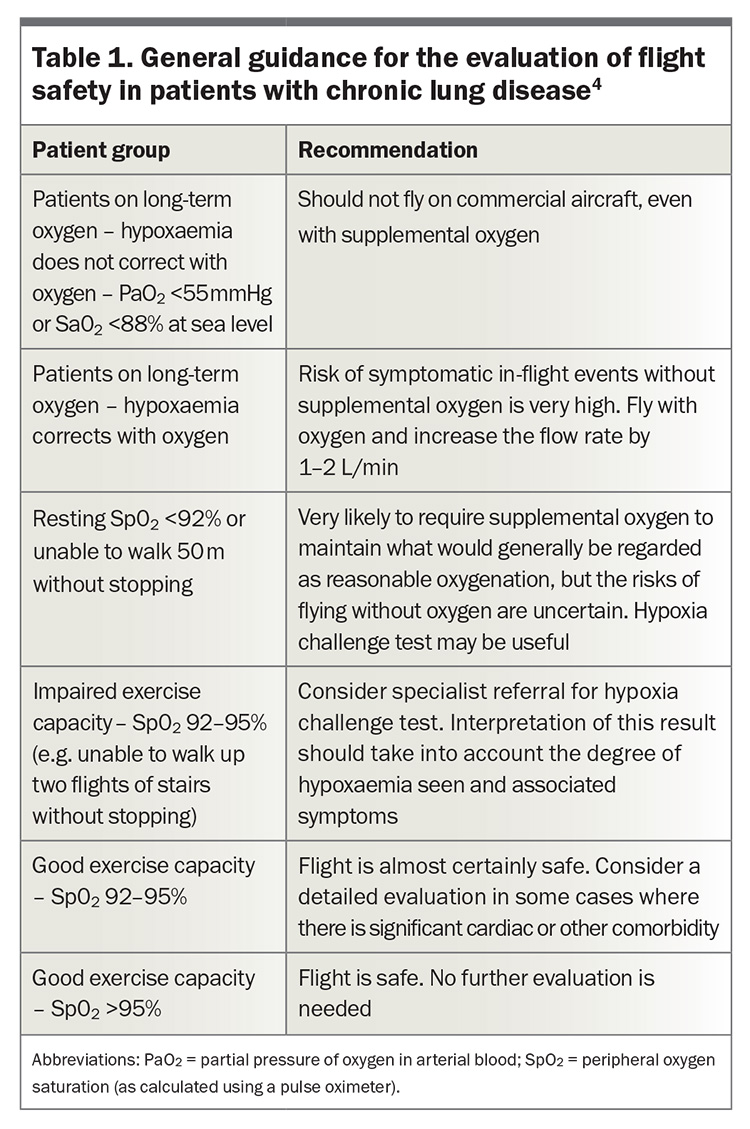
People with COPD are advised to avoid sedatives, alcohol and overeating (to avoid abdominal distension) while in flight and in transit. A pragmatic approach for evaluating flight safety in patients with COPD is described in Table 1.4 Beyond these considerations, the specific risks associated with COPD are related to changes in atmospheric pressure and oxygen availability at moderate altitude destinations and in aircraft cabins where the ambient pressure always falls during flight.
COPD, gas expansion and risks associated with changes in atmospheric pressure
The typical cruising altitude for a commercial aircraft is between 9000 and 13,000 m above sea level (ASL). The cabin is pressurised such that the ambient pressure is not lower than that seen at 2438 m ASL. This is comfortable and safe for passengers and is strictly adhered to by airlines. In practice, on modern long-haul aircrafts, this is closer to 1800 to 2100 m ASL.
Aircraft air is extremely dry, with a humidity level typically around 15%. This may lead to dehydration of airway secretions and, for patients with regular productive cough, instruction on sputum clearance can be useful.
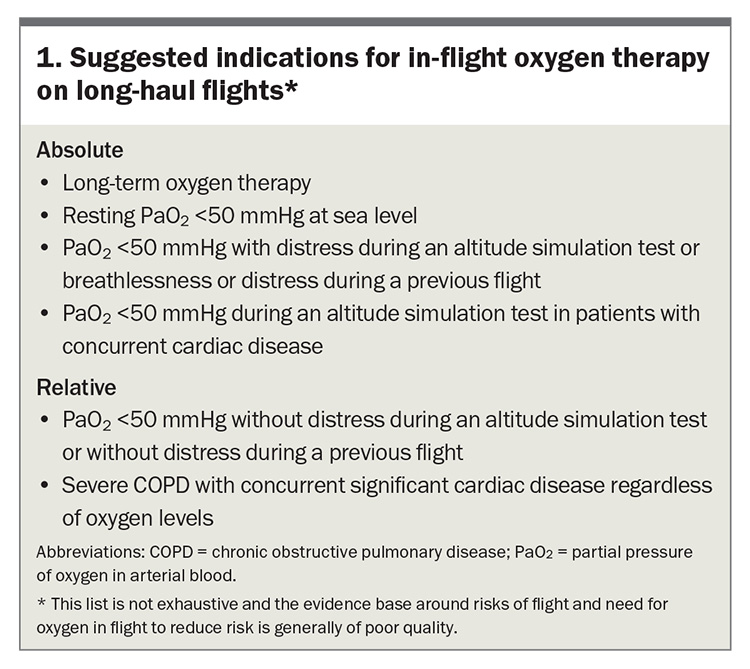
In the lower-pressure environment at 2400 m ASL, any trapped gas can expand by about 33% in volume. Patients with generalised or bullous emphysema are at low risk of cyst rupture because intra- and interlobar collateral ventilation causes even poorly ventilated lung units to decompress. Large, thin-walled cysts are at some risk of rupture with pneumothorax development, which can be catastrophic.5 This risk is not reduced by supplemental oxygen therapy that may be administered during the flight (Box 1). Reported cases of safe air travel in individuals with large thick-walled cysts or a chronic pneumothorax suggest that these cavities can withstand an increase in pressure relative to that in the adjacent lung.6
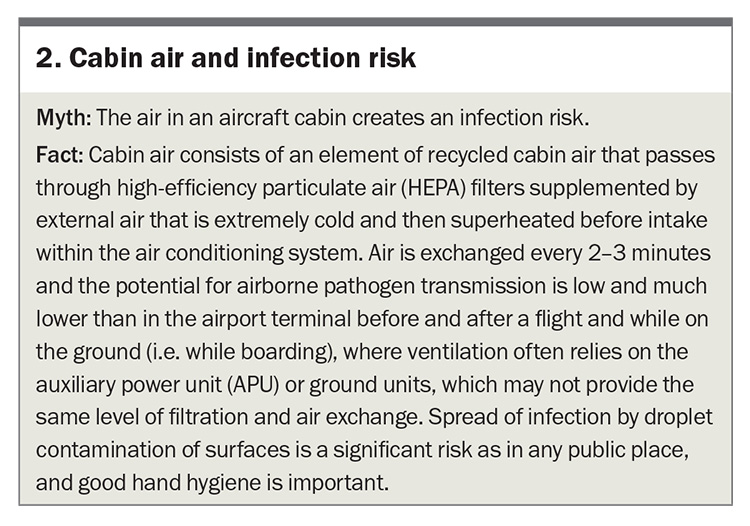
A common myth regarding cabin air and infection risk is dispelled in Box 2.
COPD, altitude, hypoxaemia and issues associated with impaired tissue oxygen delivery
At the usual cruising altitude, the alveolar partial pressure of oxygen (PAO2) for healthy individuals decreases from 103 mmHg (13.7 kPa) to 64 mmHg (8.5 kPa) and the oxygen saturation level declines from 97% to 93%.3,7 These changes are inevitable but not dangerous for the great majority. Normal adaptive mechanisms include a small increase in ventilation, increased cardiac output with the resting heart rate typically being higher by 1 beat/min/300 m altitude gained and peripheral vasodilatation.8 In addition, tissue oxygen extraction in peripheral tissues is more complete.9 Together, these processes preserve tissue oxygen delivery, despite the lower PAO2. These adaptive mechanisms explain why laboratory altitude simulation testing may produce saturation levels lower than 90% in patients who have travelled safely previously. As a general rule, supplemental oxygen is unlikely to be required if the resting oxygen saturation level is 95% or higher, whereas it is likely to be required if the oxygen saturation level is 88% or lower. Patients with oxygen saturation levels between these values might require specialist assessment.3
It follows from this that the greatest travel risk will be seen in patients who also have pulmonary hypertension or impaired cardiac function (e.g. heart failure), in whom the ability to increase cardiac output is compromised. Additionally, those with coronary or cerebral artery disease may experience impaired adaptation due to localised perfusion abnormalities, leading to tissue hypoxia and the accumulation of anaerobic metabolic byproducts. Tissue oxygen delivery may be further compromised by anaemia and oxygen utilisation by iron deficiency.
COPD, altitude and limitations to exercise capacity
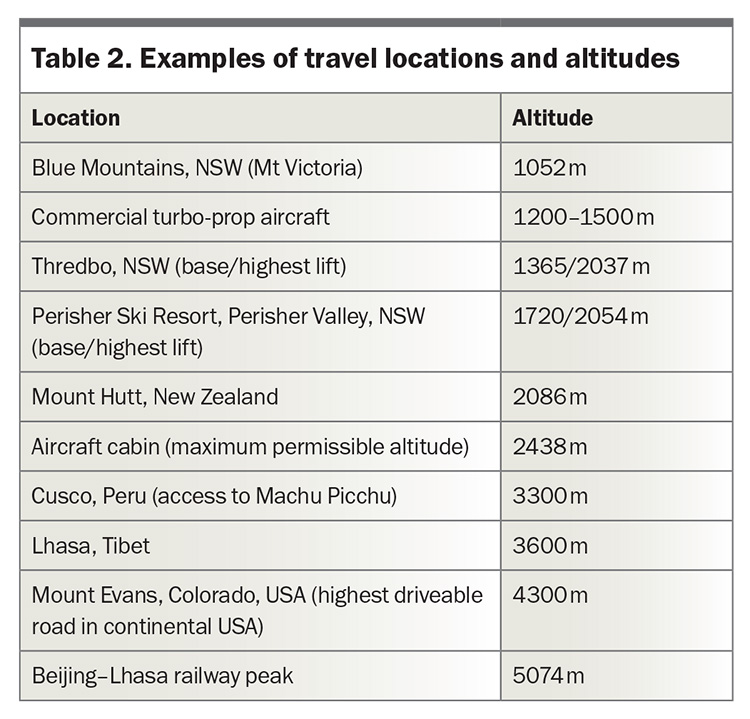
Exercise capacity declines progressively with altitude, and many high-altitude tourist destinations are readily accessible and popular among travellers (Table 2). One of the reasons that flight is generally well tolerated is that exercise demand is minimal. In a study of patients with COPD performed at Mt Hutt in New Zealand (altitude: 2086 m), a significant number of individuals were comfortable at rest but could not complete even a light exercise task.10 Therefore, sitting and relaxing in an aircraft flying at 2400 m equivalent altitude may be well tolerated, whereas travel-related tasks (e.g. dragging suitcases, walking, coping with inclines and stairs [as not all accommodations have lifts]) can generate troubling breathlessness or be impossible. However, those already on long-term oxygen therapy may need an increase in flow rate of 1 to 2 L/min during the flight and should be aware that exertion during the flight (e.g. walking to the toilet) will exacerbate hypoxaemia.
Other considerations for travel safety
When assessing flight travel safety for individuals with chronic lung disease, a variety of factors need to be taken into account, which may impact the safety and wellbeing of the traveller. In addition to the factors outlined in this article, the role of continuous positive airway pressure and other types of noninvasive ventilation should be considered. Additionally, evaluating whether hypercapnia is a concern should be part of the travel preparation process. These considerations are vital as they directly influence travel safety for individuals with COPD. Further discussion of these factors is needed to ensure that all potential risks are thoroughly addressed before embarking on a journey.
For some patients, altitude simulation or oxygen challenge testing can be an important part of assessing their readiness for travel to higher altitudes, but access to this test and a respiratory specialist may be limited. In some regions, it may take several months to secure an appointment at a public specialist clinic. In such cases, if the patient’s symptoms, comorbidities and oxygen saturation levels suggest the need for specialist referral, then GPs may wish to directly contact a respiratory physician to discuss further.
Patients with COPD considering travel to destinations of high altitude may also require specialist travel medicine advice about the prevention and management of altitude sickness.
Conclusion
The three factors to consider when faced with questions regarding travel safety for people with COPD are:
- the functional state at sea level
- the altitude to be visited
- the anticipated additional workload from physical activity while travelling.
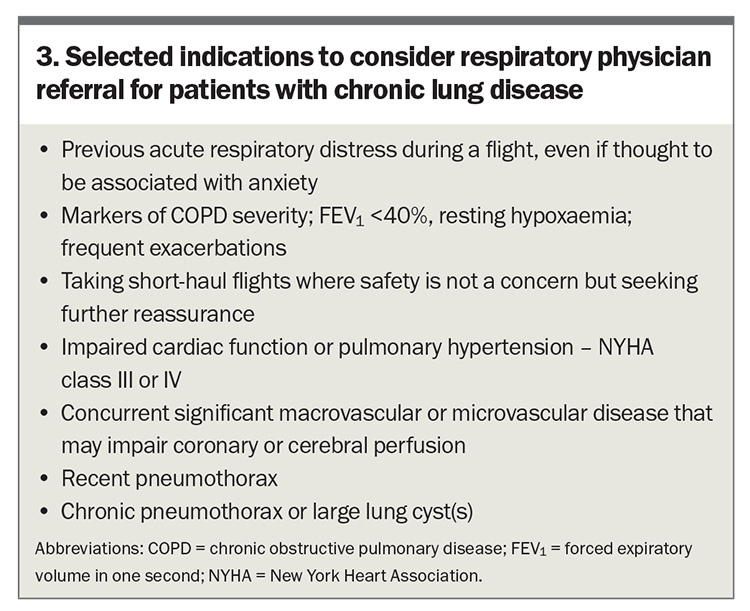
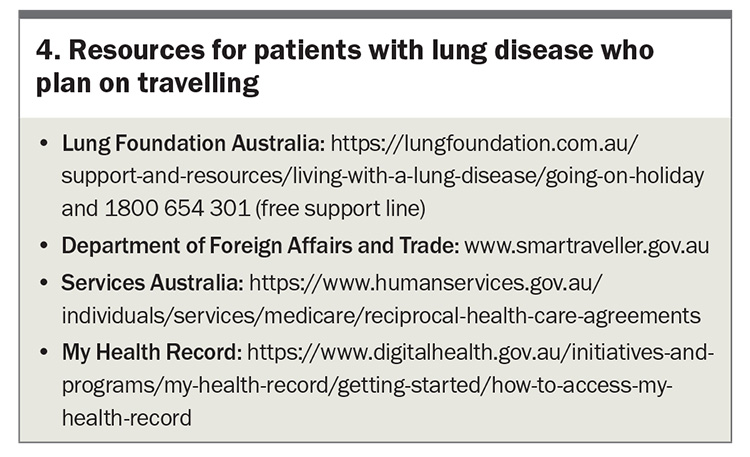
Most patients with COPD can travel without adverse events but there should be limits – not only for safety but also for circumstances where a traveller with COPD ascends to an altitude at which they are so limited by breathlessness they cannot enjoy the travel experience. Comorbidities should be considered when planning travel and in decisions associated with the need for supplementary in-flight oxygen therapy. Selected patients may benefit from referral to a respiratory physician and, in some cases, altitude simulation testing (Box 3). Resources for patients are listed in Box 4. RMT
COMPETING INTERESTS: Professor Peters: None. Dr Hancock is Chair of the Primary Care Clinical Council at Lung Foundation Australia; Chair of the Royal Australian College of General Practitioners Respiratory Medicine Special Interest Group; has received fees as a Clinical Advisor for the Australian Commission on Safety and Quality in Health Care; has received honoraria from pharmaceutical companies that develop and market medicines used in the management of chronic obstructive pulmonary disease.
References
1. Yang IA, Hancock K, George J, et al. COPD-X Handbook: Summary clinical practice guidelines for the management of chronic obstructive pulmonary disease (COPD). Milton, Queensland: Lung Foundation Australia; 2024. Available online at: https://lungfoundation.com.au/support-resources/resource-hub/copd-x-handbook/ (accessed September 2025).
2. Australian Technical Advisory Group on Immunisation (ATAGI). Australian Immunisation Handbook. Canberra: ATAGI, Australian Government; 2025. Available online at: https://immunisationhandbook.health.gov.au/ (accessed September 2025).
3. Australian Commission on Safety and Quality in Health Care (ACSQHC). Chronic obstructive pulmonary disease clinical care standard. Sydney: ACSQHC; 2024. Available online at: https://www.safetyandquality.gov.au/publications-and-resources/resource-library/chronic-obstructive-pulmonary-disease-clinical-care-standard-2024 (accessed September 2025).
4. Peters MJ, Seccombe LM. Patients with lung disease: fit to fly? Aust Fam Phys 2010; 39: 112-115.
5. Zaugg M, Kaplan V, Widmer U, Baumann PC, Russi EW. Fatal air embolism in an airplane passenger with a giant intrapulmonary bronchogenic cyst. Am J Respir Crit Care Med 1998; 157: 1686-1689.
6. Currie GP, Kennedy AM, Paterson E, Watt SJ. A chronic pneumothorax and fitness to fly. Thorax 2007; 62: 187-189.
7. Muhm JM, Rock PB, McMullin DL, et al. Effect of aircraft-cabin altitude on passenger discomfort. N Engl J Med 2007; 357: 18-27.
8. Seccombe LM, Peters MJ. Physiology in medicine: acute altitude exposure in patients with pulmonary and cardiovascular disease. J Appl Physiol 2014; 116: 478-485.
9. Wolfel EE, Selland MA, Cymerman A, et al. O2 extraction maintains O2 uptake during submaximal exercise with beta-adrenergic blockade at 4,300 m. J Appl Physiol 1998; 85: 1092-1102.
10. Kelly PT, Swanney MP, Stanton JD, Frampton C, Peters MJ, Beckert LE. Resting and exercise response to altitude in patients with chronic obstructive pulmonary disease. Aviat Space Environ Med 2009; 80: 102-107.
Single article purchases are temporarily unavailable due to site maintenance.
If you would like to purchase an article during this time, please email us at [email protected] with the article details and we'll assist you directly. We'll also let you know when online purchasing is available again.
Thank you for your patience and understanding.