
Oral corticosteroids for COPD exacerbations – one size does not fit all

The routine use of oral corticosteroids (OCS) for chronic obstructive pulmonary disease exacerbations offers limited benefit and can lead to substantial long-term harm. Emerging evidence supports eosinophil-guided, personalised treatment strategies that can be implemented in general practice to reduce OCS exposure without compromising outcomes.
- Systemic oral corticosteroid (OCS) use is widespread in patients with chronic obstructive pulmonary disease (COPD) exacerbations, yet the evidence for universal use is inconsistent.
- Repeated short OCS courses can cause significant harm with long-term toxicity, including cardiovascular disease, diabetes and osteoporosis.
- COPD exacerbations are biologically heterogeneous.
- Biomarker-guided therapy in COPD can reduce patient harm.
- Use of precision medicine for COPD is feasible in general practice.
- The future of COPD management will move beyond OCS therapy alone.
General practitioners are one of the most common prescribers of systemic oral corticosteroids (OCS), predominantly for the treatment of airways disease exacerbations for conditions such as chronic obstructive pulmonary disease (COPD).1 These short courses of OCS are deeply embedded in clinical practice and viewed as a reliable, low-cost way to restore stability when symptoms flare. However, the harms of OCS exposure have been well established: osteoporosis, hyperglycaemia, increased infection risk, mood disturbance and long-term cardiovascular complications.2 For years, we have assumed that universal OCS prescribing in patients with COPD exacerbations is the gold standard. However, are all COPD exacerbations the same, and is this the best we can offer patients in the era of evidence-based medicine?
This review revisits the key evidence behind OCS use in patients with COPD exacerbations, explores recent advances in biomarker-guided management and highlights how general practice can help lead the transition toward personalised and precision medicine in the management of COPD.
What is the evidence for OCS in COPD exacerbations?
International and national COPD guidelines have long recommended systemic corticosteroids for most exacerbations.3 The rationale is straightforward: to hasten recovery of lung function, relieve breathlessness and reduce the risk of relapse or hospital admission. OCS (typically dosed at 30 to 50 mg daily for five days) has become standard first-line therapy in both primary care and hospital settings for the management of COPD exacerbations.4 However, the evidence base for this universal approach is weaker than many realise.
A 2014 Cochrane review by Walters et al. analysed 13 randomised controlled trials comparing systemic corticosteroids with placebo for COPD exacerbations.5 Although systemic corticosteroids did shorten recovery time and reduce early treatment failure in some studies, the overall benefits were inconsistent. Only two trials showed a statistically significant reduction in relapse risk at one month (n=415; hazard ratio, 0.78; 95% confidence interval [CI], 0.63 to 0.97), and improvements in quality of life and lung function were modest. The likely reason for this negative result was because the studies included in the review did not use eosinophil- guided treatment. The largest outpatient study included in the review showed a delay in relapse rate at day 30 and improved dyspnoea at day 10; however, there were no differences in health-related quality of life measures.6 Importantly, the review concluded that overall corticosteroid-related adverse effects (including hyperglycaemia, weight gain and psychiatric events), were roughly twice as common compared with placebo in eight studies (n=736; odds ratio, 2.33; 95% CI, 1.59 to 3.43).
In primary care, where patients with COPD are often older and multimorbid, these adverse effects are particularly relevant. Even short courses of prednisolone can cause fluid retention, insomnia and mood changes, and repeated courses accelerate osteoporosis and diabetes progression. More concerningly, cumulative OCS toxicity is now recognised as a growing problem, with 1000 mg lifetime OCS exposure leading to increased risk of adverse effects.7 Yet despite these known harms, few studies have evaluated OCS use in the general practice setting, where most patients with COPD exacerbations present and most OCS prescriptions are written.
Why do OCS work in some patients and not others?
The concept of ‘one-size-fits-all’ treatment for patients with COPD exacerbations is increasingly being challenged. We now know that COPD is a heterogeneous disease, with multiple inflammatory pathways driving exacerbations. About one-third of patients exhibit a type 2 inflammatory pattern as shown by both sputum and peripheral eosinophilia.8-10 The relation between eosinophilia and corticosteroid responsiveness in airways disease was first described in 1958 by Brown et al., who found that the presence of sputum eosinophilia predicted corticosteroid responsiveness and improved outcomes in patients with asthma.11 With this knowledge in hand, modern research has sought to prove this same theory in patients with COPD with evidence of type 2 inflammation, ushering in an era of biomarker-guided precision therapy for COPD.
Biomarker-guided precision therapy for COPD was first demonstrated in the landmark study by Bafadhel et al.12 In this trial of patients with moderate COPD exacerbations, participants were randomised to either standard care (all receiving oral prednisolone) or eosinophil-guided therapy. Within the eosinophil-guided group, participants with elevated blood eosinophils received oral prednisolone and participants with low eosinophil counts received placebo. The results were striking: the eosinophil-guided group experienced fewer relapses needing further treatment compared with the standard care group (5% vs 13%; 95% CI, –1 to 16; p=0.07), despite a 49% reduction in overall prednisolone use. In this well-powered study, lung function and symptom recovery using the Chronic Respiratory Disease Questionnaire (CRQ) score (0.8 in the standard care group vs 1.1 in the eosinophil-guided care group; mean difference, 0.3; 95% CI, 0.0 to 0.6; p=0.05) were equivalent between groups (CRQ minimal clinically important difference [MCID] of 0.5), confirming that patients without eosinophilic inflammation gained no measurable benefit from OCS.
More relevant for general practice, the Studying Acute Exacerbations and Response (STARR2) study brought this concept into the primary care setting for COPD exacerbations.13 Conducted across 14 general practices, the study used point-of-care eosinophil testing at the time of exacerbation to guide prednisolone prescribing. Eosinophil-guided therapy was noninferior to standard care, reduced prednisolone use by 33% and achieved a 40% lower rate of treatment failure at 30 days compared with standard care (relative risk, 0.60; 95% CI, 0.33 to 1.04; p=0.07). This study shows that precision medicine is not confined to hospitals or specialist clinics – it can be safely and effectively implemented in everyday general practice.
Beyond general practice: what else can we offer?
Although biomarker-guided OCS therapy marks an important step forward in COPD management, further innovation is on the horizon. The Acute exacerbations treated with BenRAlizumab (ABRA) trial investigated whether biologic therapy could perform better than OCS in acute eosinophilic exacerbations.14 Patients with COPD and asthma who had blood eosinophils 0.3 × 10⁹/L or greater were randomised to receive either oral prednisolone, benralizumab (an anti-interleukin-5 receptor monoclonal antibody) or both. Benralizumab significantly reduced treatment failure at 90 days by 29%, with a number needed to treat of just four. Symptom improvement using the Visual Analogue Scale (MCID of 10 mm) was also greater in the benralizumab group, although lung function recovery and quality of life were similar. It should be noted that benralizumab is not currently licensed for use in acute exacerbations of COPD and that further data are needed before this approach can be recommended.
The use of biologics has been well established in the management of patients who experience frequent asthma exacerbations and, more recently, has been shown to improve outcomes in patients who experience recurrent COPD exacerbations. A pooled analysis of both the NOTUS and BOREAS trials evaluating the use of dupilumab as an add-on therapy in highly selected patients with moderate COPD, eosinophilia and recurrent exacerbations showed that dupilumab reduced the annualised rate of moderate-to-severe COPD exacerbations compared with placebo (annualised exacerbation rate 0.794 in the dupilumab group and 1.156 in the placebo group; incidence rate ratio, 0.687; 95% CI, 0.595 to 0.793; p<0.0001).15 Furthermore, the time to the first severe exacerbation was reduced in the dupilumab group compared with placebo. For general practitioners, prescribing biologics is not an option due to Australian PBS restrictions; however, it points to a future where COPD care could be tailored to the underlying cause of inflammation rather than defaulting to OCS.
Implementing personalised and precision medicine in general practice
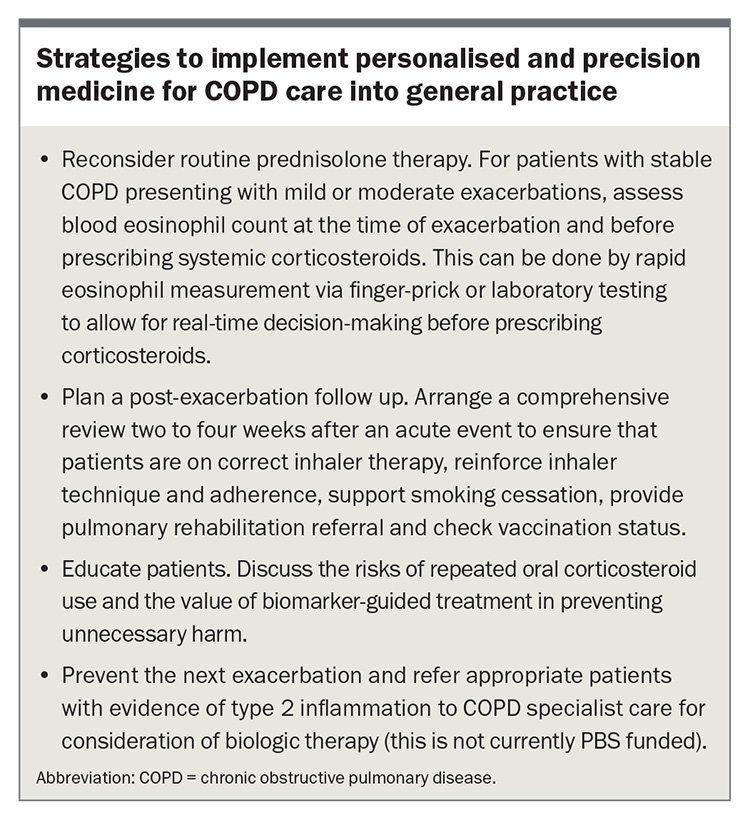
Despite growing evidence for targeted treatment, COPD exacerbations remain a major burden in patients presenting in general practice. Each event not only accelerates a patient’s lung function decline but also increases the risk of further exacerbations and hospitalisation. The post-exacerbation period is a time of heightened vulnerability with studies showing increased risk of acute coronary syndrome, cerebrovascular events, heart failure and arrhythmia in the first 30 days after a COPD exacerbation.16 To change outcomes, we must move from reactive to proactive care.
The strategies shown in the Box can be used to implement both personalised and precision medicine for COPD care into general practice.
Conclusion
The management of COPD exacerbations is entering a new era, one that moves beyond reflexive OCS prescribing toward tailored, evidence-based care. Recent studies show that eosinophil-guided therapy can safely reduce OCS exposure without compromising recovery, even in the community setting. Although the current COPD guidelines are yet to reflect this new and emerging evidence, general practitioners are ideally placed to lead this transition towards precision medicine once guidelines are updated. By incorporating biomarker testing, personalising therapy, and adopting a stewardship mindset, general practitioners can improve patient outcomes while reducing harm. The future of COPD management lies not in treating every exacerbation the same way, but in understanding the biological mechanisms that are driving each one. RMT
COMPETING INTERESTS. Dr Menon has received conference travel support from GSK. Dr Ramakrishnan has received salary support from Charlie’s Research Foundation, National Institute for Health and Care Research; speaker fees from AstraZeneca, Chiesi, GSK, Sanofi and Boehringer Ingelheim; conference travel support from AstraZeneca, Boehringer Ingelheim and Sanofi; advisory board attendance for GSK, Sanofi and AstraZeneca; and consulting fees from Connect BioPharma.
References
1. Wallace BI, Tsai HJ, Lin P, et al. Prevalence and prescribing patterns of oral corticosteroids in the United States, Taiwan, and Denmark, 2009-2018. Clin Transl Sci 2023; 16: 2565-2576.
2. Spies TD, Stone RE, Garcia Lopez G, et al. Prednisone and prednisolone as therapeutic agents; progress report on their integration into general medical practice. J Am Med Assoc 1955; 159: 645-652.
3. Global Initiative for Chronic Obstructive Lung Disease (GOLD). Global strategy for the diagnosis, management, and prevention of chronic obstructive pulmonary disease. Updated 2025. Fontana: GOLD; 2025. Available online at: https://goldcopd.org/2025-gold-report/ (accessed March 2026).
4. Yang IA, George J, McDonald CF, et al. The COPD-X Plan: Australian and New Zealand guidelines for the management of chronic obstructive pulmonary disease 2025. Version 2.78. Milton: Lung Foundation Australia; 2025. Published online 18 December 2025 https://copdx.org.au/copd-x-plan/ (accessed March 2026).
5. Walters JA, Tan DJ, White CJ, Gibson PG, Wood-Baker R, Walters EH. Systemic corticosteroids for acute exacerbations of chronic obstructive pulmonary disease. Cochrane Database Syst Rev 2014; 2014(9): CD001288.
6. Aaron SD, Vandemheen KL, Hebert P, et al. Outpatient oral prednisone after emergency treatment of chronic obstructive pulmonary disease. N Engl J Med 2003; 348: 2618-2625.
7. Blakey J, Chung LP, McDonald VM, et al. Oral corticosteroids stewardship for asthma in adults and adolescents: a position paper from the Thoracic Society of Australia and New Zealand. Respirology 2021; 26: 1112-1130.
8. Kolsum U, Southworth T, Jackson N, Singh D. Blood eosinophil counts in COPD patients compared to controls. Eur Respir J 2019; 54: 1900633.
9. Maniscalco M, Candia C, Ambrosino P, Iovine A, Fuschillo S. Chronic obstructive pulmonary disease’s eosinophilic phenotype: clinical characteristics, biomarkers and biotherapy. Eur J Intern Med 2025; 131: 27-35.
10. Hasegawa K, Camargo CA, Jr. Prevalence of blood eosinophilia in hospitalized patients with acute exacerbation of COPD. Respirology 2016; 21: 761-764.
11. Brown HM. Treatment of chronic asthma with prednisolone; significance of eosinophils in the sputum. Lancet 1958; 2: 1245-1247.
12. Bafadhel M, McKenna S, Terry S, et al. Blood eosinophils to direct corticosteroid treatment of exacerbations of chronic obstructive pulmonary disease: a randomized placebo-controlled trial. Am J Respir Crit Care Med 2012; 186: 48-55.
13. Ramakrishnan S, Jeffers H, Langford-Wiley B, et al. Blood eosinophil-guided oral prednisolone for COPD exacerbations in primary care in the UK (STARR2): a non-inferiority, multicentre, double-blind, placebo-controlled, randomised controlled trial. Lancet Respir Med 2024; 12: 67-77.
14. Ramakrishnan S, Russell REK, Mahmood HR, et al. Treating eosinophilic exacerbations of asthma and COPD with benralizumab (ABRA): a double-blind, double-dummy, active placebo-controlled randomised trial. Lancet Respir Med 2025; 13: 59-68.
15. Bhatt SP, Rabe KF, Hanania NA, et al. Dupilumab for chronic obstructive pulmonary disease with type 2 inflammation: a pooled analysis of two phase 3, randomised, double-blind, placebo-controlled trials. Lancet Respir Med 2025; 13: 234-243.
16. Pirera E, Di Raimondo D, D’Anna L, Tuttolomondo A. Risk trajectory of cardiovascular events after an exacerbation of chronic obstructive pulmonary disease: a systematic review and meta-analysis. Eur J Intern Med 2025; 135: 74-82.
Single article purchases are temporarily unavailable due to site maintenance.
If you would like to purchase an article during this time, please email us at [email protected] with the article details and we'll assist you directly. We'll also let you know when online purchasing is available again.
Thank you for your patience and understanding.