
Alpha-1 antitrypsin deficiency: recognising and managing an underdiagnosed cause of lung disease
Alpha-1 antitrypsin deficiency is an underdiagnosed inherited disorder that increases the risk of early-onset emphysema. Recognition in people with chronic airflow obstruction, adult-onset asthma and emphysema disproportionate to smoking history can enable earlier diagnosis, advice on smoking avoidance, family screening and more targeted management.
- Alpha-1 antitrypsin deficiency (AATD) is an autosomal codominant disorder caused by SERPINA1 mutations, leading to low circulating alpha-1 antitrypsin levels and an increased risk of emphysema, chronic liver disease, panniculitis and systemic vasculitis.
- The classic pulmonary phenotype is early-onset, panlobular, basal-predominant emphysema, particularly in current or former smokers, although clinically important lung disease also occurs in never-smokers.
- AATD should be considered in people with chronic airflow obstruction, adult-onset asthma with persistent airflow limitation, emphysema disproportionate to their smoking history, or concurrent liver or skin disease.
- Diagnosis begins with serum alpha-1 antitrypsin measurement by nephelometry, followed by phenotyping and genotyping when levels are reduced; in addition, genetic counselling should be considered for affected individuals and at-risk family members.
- Management includes standard chronic obstructive pulmonary disease or asthma care, with smoking cessation as an important intervention. Lung transplantation remains the gold-standard treatment for severe AATD-related chronic obstructive pulmonary disease. Augmentation therapy has limited availability in Australia, but emerging therapies may expand future treatment options.
Alpha-1 antitrypsin (AAT) is a serpin protein encoded by the gene SERPINA1 on chromosome 14.1,2 AAT is a protease inhibitor synthesised predominantly in the liver that protects tissues from the harmful effects of inflammatory proteases, including neutrophil elastase.3 AAT deficiency (AATD) is a genetic condition associated with the development of emphysema and chronic liver disease.4-6 AATD occurs in the setting of mutations in the SERPINA1 gene that result in low circulating plasma levels of AAT. These mutations result in misfolding of the AAT protein, causing degradation within hepatocytes and lead to proteotoxic stress that may then lead to chronic liver damage and cirrhosis.7 The subsequent decrease in available circulating AAT leads to an imbalance between antiprotease and protease activity within the lung, resulting in uninhibited inflammatory neutrophil elastase causing damage to the extracellular matrix, and resultant emphysema.1,7,8
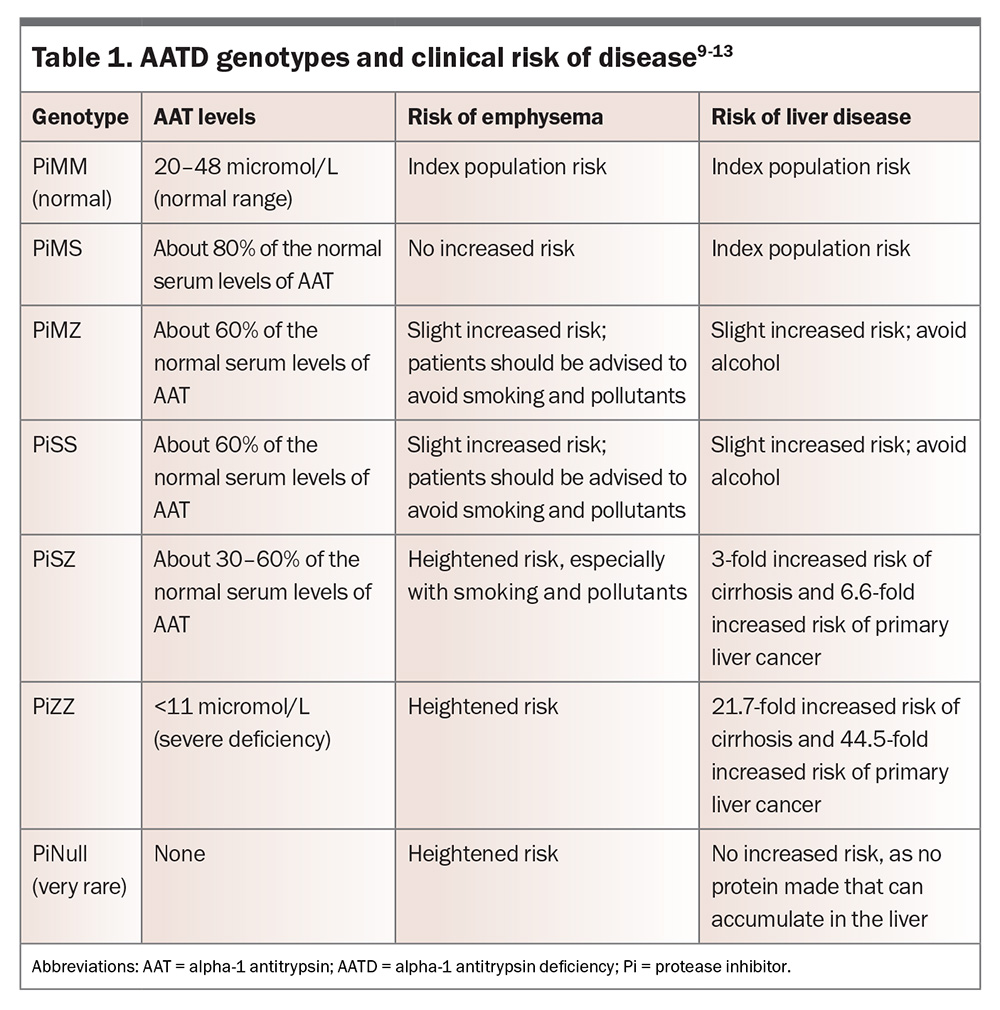
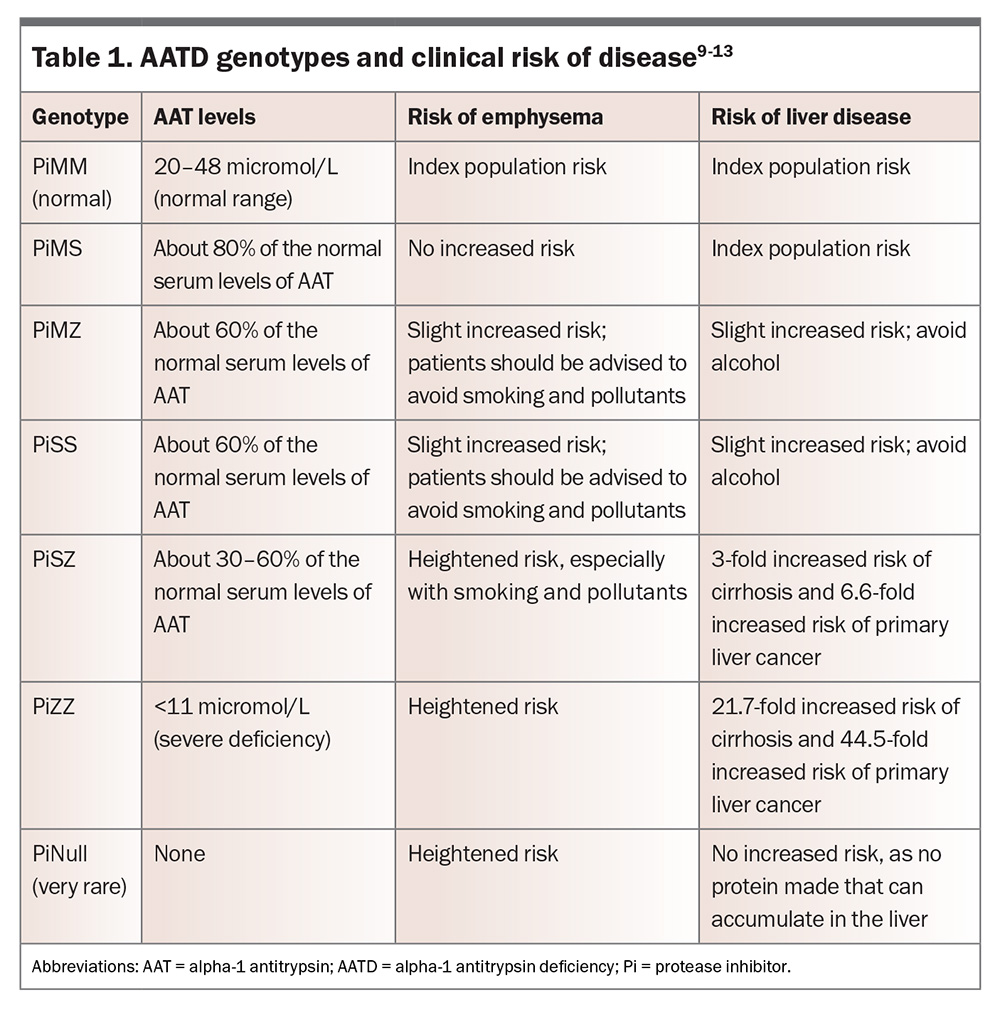
AATD is inherited in an autosomal codominant manner. The normal genotype is designated protease inhibitor (Pi)MM. The most common genetic mutation resulting in AATD is a point mutation of Glu342Lys vE342K), resulting in the Z allele which leads to significantly decreased levels of circulating AAT.7 Other genotypes include the M, S and null alleles, each resulting in a range of circulating AAT and carrying different levels of risks of lung and liver disease, as summarised in Table 1.9-13
The epidemiology of AATD varies significantly according to geographic region and genetic background. It has been recorded more frequently in people of Caucasian European descent, although AATD is recognised to affect people from a range of ethnic backgrounds.14,15 The 2020 position statement on the diagnosis and treatment of AATD from the Thoracic Society of Australia and New Zealand estimated that more than 30,000 people in the two countries have the disease.4 AATD is underdiagnosed, and is likely to be even more so in minority groups; therefore, careful consideration of the disease should be made in the appropriate clinical context.15-17
Classic presentation
AATD represents a broad spectrum of disease, ranging from asymptomatic cases identified on screening to those who develop severe obstructive lung disease or cirrhosis.18 Distinct from the pulmonary manifestations of disease, the abnormal AAT protein can accumulate in the liver, leading to fibrosis and cirrhosis, with an associated increased risk of hepatocellular carcinoma.18 In addition, individuals with severe AAT deficiency are at increased risk of panniculitis and systemic vasculitis.18-21 This article will focus on the pulmonary manifestations of the disease.
The classic pulmonary manifestation of AATD is early-onset (<45 years of age), panlobular, basal-predominant emphysema, disease that mostly occurs in those who are current or former smokers.4,18,22 Other patterns of pulmonary disease – including upper-zone predominant emphysema and bronchiectasis, as well as partially reversible airflow obstruction – can also be seen.4 Patients most often present with dyspnoea, cough and wheeze.18-20 AATD-related chronic obstructive pulmonary disease (COPD) develops earlier than traditional COPD, and is associated with higher rates of exacerbations and greater healthcare utilisation.23,24 AATD has been associated with mortality rates up to 4.7 times higher than those in the general population.25,26 Bronchiectasis is also associated with AATD. Although it is usually seen in conjunction with emphysema, it occurs in up to 10% of cases and is rarely the sole cause of bronchiectasis.27
Diagnosis
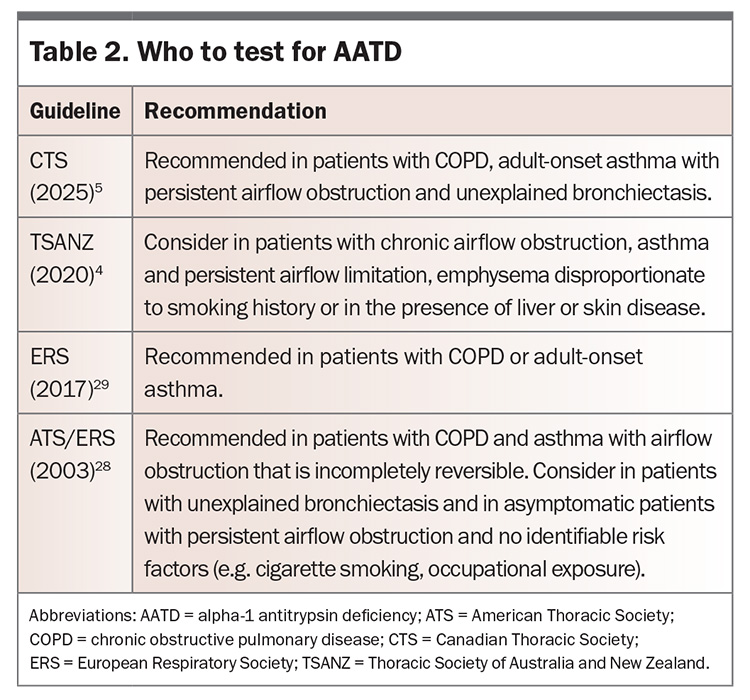
Some international guidelines, including those by the Canadian Thoracic Society or the American Thoracic Society and the European Respiratory Society, recommend testing for AATD in all patients with COPD, adult-onset asthma and bronchiectasis.5,28,29 However, local guidelines from the Thoracic Society of Australia and New Zealand suggest considering testing in patients with chronic airflow obstruction, adult-onset asthma with persistent airflow limitation, emphysema disproportionate to their smoking history, or concurrent liver or skin disease.4-6,30 Various international guidelines on who to test for AATD are summarised in Table 2.4,5,28,29 AATD is diagnosed based on measurement of serum AAT levels using an immunoassay method called nephelometry.4 An AAT level of 20 micromol/L or higher using nephelometry, in the absence of an acute inflammatory state, is considered normal.31 Circulating AAT levels between 11 and 20 micromol/L are usually associated with either a single allele deficiency (PiMS, PiMZ) or PiSS, whereas levels less than 11 micromol/L are most frequently associated with the PiZZ genotype or the rare null mutation.32 When low levels of circulating AAT are detected, AAT genotyping (with or without phenotyping) should be the next step.31
Genotyping by analysis of DNA samples using polymerase chain reaction testing with specific AATD primers can be used to elucidate the underlying genetic basis of a patient’s disease and is the preferred next test after measurement of AAT levels.4,31 Phenotyping is performed using isoelectric focusing and identifies the AAT proteins present in a patient’s plasma sample based on different patterns of migration through a gel medium. This allows identification of the distinct AAT proteins that may be present (e.g. PiM, PiS, PiZ) and determination of the likely underlying genotype (Table 1).9-13,31 Patients diagnosed with AATD should be referred to genetic counselling services to assist with informed decision-making and screening of at-risk family members.4 For those with AATD and respiratory disease, the risk of disease progression is increased and review by a respiratory physician is advisable.
AATD and smoking
The most important modifiable risk factor for the development of respiratory symptoms in patients with AATD is cigarette smoking.20 Environmental smoke exposure and childhood infections have also been shown to accelerate the onset of symptoms.20 Cigarette smoking in patients with AATD is associated with an increased rate of FEV1 decline. In an adult cohort of 608 patients with PiZZ AATD, the adjusted mean change in FEV1 among never-smokers was 47 mL per year (95% confidence interval [CI] 41–53 mL/year) and, in current smokers, 70 mL per year (95% CI 58–82 mL/year). Those who ceased smoking were found to return to a similar rate of decline to that of never-smokers without airways disease (41 mL/year; 95% CI 36–48 mL/year).33
AATD in never-smokers
Although cigarette smoking is heavily implicated in the development of emphysema in patients with AATD, never-smokers with AATD are still at risk of pulmonary disease.34 Compared with smokers in the general population, never-smokers with severe AATD have been shown to have a higher FEV1, slower lung function decline, fewer respiratory symptoms and improved survival.35 However, a significant proportion of never-smokers with the PiZZ genotype still develop lung disease. The European Alpha-1 Research Collaboration found that, among 442 never-smokers older than 35 years of age with PiZZ AATD, 330 (75%) had some form of respiratory disease (e.g. emphysema, bronchiectasis, asthma).34
Compared to PiZZ never-smokers without airflow obstruction on spirometry, those with airflow obstruction were more likely to report dyspnoea and to have more cough and sputum production. They were also more likely to have emphysema (66.3%) compared with those with no airflow obstruction (16.7%), and have a lower carbon monoxide transfer coefficient. A similar proportion in both groups had bronchiectasis (28.8% in never-smokers with airflow obstruction vs 29.2% in never-smokers without airflow obstruction).34 Therefore, normal spirometry did not rule out either emphysema or bronchiectasis in this group. A separate study found that in individuals with a PiZZ genotype, occupational exposure to dust, fumes and smoke is associated with increased cough, dyspnoea and lower lung function, independent of tobacco smoking.36 Despite this, never-smokers with the PiZZ genotype have been shown to have a life expectancy similar to that of individuals without AATD.37
Clear guidelines or recommendations do not exist on how to assess and manage AATD in never-smokers or those with occupational exposures. In those with AATD and potential occupational exposure, risk is influenced by multiple factors, including the degree of enzyme deficiency. For people with AATD who work in at-risk industries, it is reasonable to provide counselling about their increased susceptibility, discuss the personal risks and benefits of continuing this work, and advise minimising exposure, especially to mineral dusts. It is also reasonable to consider assessment of all such patients with a history of respiratory symptoms, especially cough, sputum and dyspnoea, including spirometry and measurement of gas transfer factor. Given that spirometry is less sensitive than high-resolution CT of the chest for detecting emphysema and bronchiectasis, a CT scan should be performed in those with symptoms or airflow obstruction, although it should be noted that routine serial CT imaging is not currently recommended.30
In patients with severe asthma, AATD may be overrepresented and is likely to worsen asthma control. A study looking at 847 people with severe asthma in the USA found that having even one Z allele was associated with an increased risk of emergency department visits or hospitalisation, and AAT levels were inversely correlated with exacerbation risk.38 This provides further support for the recommendation that patients with severe or adult-onset asthma be evaluated for AATD.28,29
Treatment
Management of AATD-related COPD should include all nonpharmacological and pharmacological measures that are applied to patients with COPD unrelated to AATD. These include smoking cessation support; vaccination against influenza, COVID-19, respiratory syncytial virus and pneumococcal disease; pulmonary rehabilitation; and inhaler therapy. Despite limited evidence supporting the use of these therapies in AATD-related COPD, treatment recommendations have been extrapolated from the general COPD population.4,39 A similar paradigm exists for the management of AATD-related asthma, although the evidence base for this is even more limited.40
Smoking cessation
Smoking cessation has been shown to increase survival among patients with AATD who have an FEV1 less than 50% predicted (relative risk 0.40; 95% CI 0.22–0.71).41 Current smokers should be offered nonpharmacological and pharmacological support to assist smoking cessation.42-44 Pharmacotherapy with nicotine replacement therapy or varenicline (or, in some cases, bupropion) plus counselling should be considered standard of care.45 Combination nicotine replacement therapy (transdermal patch plus gum, lozenge, spray or inhalator) has been shown to be more effective than single-agent nicotine replacement therapy.46
Genetic testing for AATD has been shown to positively affect smoking cessation rates.47,48 In an Irish registry-based study of 293 people with AATD, 70.7% of all current smokers quit following a diagnosis of AATD, including 92% of those with the PiZZ genotype.44 The expansion of direct-to-consumer genetic testing may increase diagnosis of the disease and could lead to greater smoking avoidance or cessation.48
Augmentation therapy
Augmentation therapy is the replacement of circulating AAT to above a threshold considered protective against the deleterious effects of excessive protease activity, and outside of the clinical trial setting is the only currently available targeted therapy for AATD.4,5 Augmentation therapy consists of intravenous administration of exogenous AAT derived from pooled donated blood products.4 It has been shown to reduce decline in lung densitometry, a quantitative assessment of lung density validated for use in emphysema.49-52 A meta-analysis consisting of three randomised controlled trials demonstrated a reduction in lung density decline with augmentation therapy by a pooled mean difference of 0.86 g/L per year (95% CI 0.31–1.42, p = 0.002).50 In randomised controlled trials, augmentation therapy has not been shown to improve lung function parameters, including change in FEV1 or the diffusing capacity of the lungs for carbon monoxide.51,53,54 However, one retrospective cohort study demonstrated a significant reduction in annual FEV1 decline with augmentation therapy (53 mL/year [95% CI 48–58] vs 75 mL/year [95% CI 63–87 mL/year], p = 0.02).55 Nonrandomised data have suggested that augmentation therapy may confer a mortality benefit; however, in randomised controlled trials it has not been shown to reduce the rate of COPD exacerbations, improve quality of life or improve functional capacity as measured by a six-minute walk distance.51,53,56 Augmentation therapy has been shown to have an acceptable adverse effect profile over an extended treatment duration.52
There are currently two TGA-approved alpha1-proteinase inhibitor preparations available in Australia. However, augmentation therapy is not currently subsidised by the Australian BloodSTAR scheme and access is therefore limited. Augmentation therapy is not recommended in patients who are current smokers due to concerns regarding efficacy.4
Lung transplant
Lung transplantation remains the definitive treatment for severe AATD-related COPD, and in appropriately selected patients is associated with an improved quality of life and survival. Referral for consideration of lung transplantation should be considered in those with severe airflow limitation (FEV1 less than 25% predicted).4,39,57
Emerging treatments
Given the limitations of augmentation therapy, including access to treatment in Australia, several emerging areas of research are under investigation. Both inhaled and subcutaneous AAT have been explored with mixed reported outcomes, but no commercially available product yet exists.58
Gene editing has also emerged as a potential novel therapy. The Z allele arises from a single G to A point mutation at the E342K position on the SERPINA1 gene.58 This point mutation results in a conformational change in the AAT protein and the subsequent liver and pulmonary complications of the disease. Several DNA editing strategies have shown promising outcomes in the preclinical setting, including base editing to correct the E342K mutation and murine knock-in models of the normal SERPINA1 sequence to allow the expression of normal AAT protein.58 RNA-based therapies have also shown potential. By targeting the SERPINA1 mRNA with small interfering RNA molecules, expression of the abnormal AAT mRNA can be prevented, resulting in reduced abnormal AAT protein synthesis.59 There is also emerging work targeting the abnormal AAT protein itself, with a focus on correction of abnormal folding and promotion of degradation of abnormal protein polymers.59
Conclusion
AATD is underdiagnosed and should be considered in the assessment of people with chronic airflow obstruction, adult-onset asthma with persistent airflow limitation, emphysema disproportionate to their smoking history, or concurrent liver or skin disease. In these patients, serum AAT levels should be measured and, if reduced, genotyping and phenotyping should be performed. AATD and the discovery of potentially disease-causing mutations are increasingly recognised in people without a history of smoking, and this is likely to increase with the expanding use of genetic testing. Individuals with AATD, including never-smokers, with a history of respiratory symptoms (e.g. cough, sputum, dyspnoea) should be assessed with a clinical history and lung function. For those with symptoms of airflow obstruction, high-resolution CT of the chest should also be performed.
In all patients with reduced AAT levels, avoidance of smoking, and reducing exposure to external and indoor pollutants is strongly advised. In those with COPD and asthma, treatment is as per usual care; however, a diagnosis of AATD confers an increased risk of disease progression and exacerbations, and respiratory specialist review is recommended. At present, the role of augmentation therapy remains uncertain and its availability in Australia is limited. However, emerging treatments, including disease-modifying therapies, offer significant future potential for patients. RMT
COMPETING INTERESTS: Dr Donnan: None. Professor Wark has previously received honoraria from Vertex Pharmaceuticals.
References
1. Stoller JK, Aboussouan LS. Alpha1-antitrypsin deficiency. Lancet 2005; 365: 2225-2236.
2. Köhnlein T, Welte T. Alpha-1 antitrypsin deficiency: pathogenesis, clinical presentation, diagnosis, and treatment. Am J Med 2008; 121: 3-9.
3. Stoller JK, Aboussouan LS. A review of alpha1-antitrypsin deficiency. Am J Respir Crit Care Med 2012; 185: 246-259.
4. Dummer J, Dobler CC, Holmes M, et al. Diagnosis and treatment of lung disease associated with alpha one‐antitrypsin deficiency: a position statement from the Thoracic Society of Australia and New Zealand. Respirology 2020; 25: 321-335.
5. Hernandez P, Bossé Y, Bush P, et al. Alpha-1-antitrypsin deficiency targeted testing and augmentation therapy: a Canadian Thoracic Society meta-analysis and clinical practice guideline. Chest 2025; 167: 1044-1063.
6. Yang I, George J, McDonald C, et al. The COPD-X plan: Australian and New Zealand guidelines for the management of chronic obstructive pulmonary disease 2025. Version 2.78. Brisbane: Lung Foundation Australia; 2025. Available online at: https://copdx.org.au/copd-x-plan/ (accessed March 2026).
7. Strnad P, McElvaney NG, Lomas DA. Alpha1-antitrypsin deficiency. N Engl J Med 2020; 382: 1443-1455.
8. Gooptu B, Ekeowa UI, Lomas DA. Mechanisms of emphysema in alpha1-antitrypsin deficiency: molecular and cellular insights. Eur Respir J 2009; 34: 475-488.
9. Franciosi AN, Hobbs BD, McElvaney OJ, et al. Clarifying the risk of lung disease in SZ alpha-1 antitrypsin deficiency. Am J Respir Crit Care Med 2020; 202: 73-82.
10. Martinez-González C, Blanco I, Diego I, Bueno P, Miravitlles M. Estimated prevalence and number of PiMZ genotypes of alpha-1 antitrypsin in seventy-four countries worldwide. Int J Chronic Obstr Pulm Dis 2021; 16: 2617-2630.
11. Molloy K, Hersh CP, Morris VB, et al. Clarification of the risk of chronic obstructive pulmonary disease in alpha1-antitrypsin deficiency PiMZ heterozygotes. Am J Respir Crit Care Med 2014; 189: 419-427.
12. Hiller AM, Ekström M, Piitulainen E, Lindberg A, Rönmark E, Tanash H. Cancer risk in severe alpha-1-antitrypsin deficiency. Eur Respir J 2022; 60: 2103200.
13. Fromme M, Schneider CV, Pereira V, et al. Hepatobiliary phenotypes of adults with alpha-1 antitrypsin deficiency. Gut 2022; 71: 415-423.
14. de Serres FJ. Worldwide racial and ethnic distribution of alpha1-antitrypsin deficiency summary of an analysis of published genetic epidemiologic surveys. Chest 2002; 122: 1818-1829.
15. Luisetti M, Seersholm N. Alpha1-antitrypsin deficiency. 1: epidemiology of alpha1-antitrypsin deficiency. Thorax 2004; 59: 164.
16. McElvaney OJ, Hagstrom J, Foreman MG, McElvaney NG. Undiagnosed alpha-1 antitrypsin deficiency and the perpetuation of lung health inequity. Am J Respir Crit Care Med 2023; 209: 3-5.
17. Lafortune P, Zahid K, Ploszaj M, Awadalla E, Carroll TP, Geraghty P. Testing alpha-1 antitrypsin deficiency in black populations. Adv Respir Med 2023; 92: 1-12.
18. Tejwani V, Stoller JK. The spectrum of clinical sequelae associated with alpha-1 antitrypsin deficiency. Ther Adv Chronic Dis 2021; 12(Suppl): 2040622321995691.
19. McElcaney NG, Stoller JK, Buist AS, et al. Baseline characteristics of enrollees in the National Heart, Lung and Blood Institute Registry of alpha1-antitrypsin deficiency. Chest 1997; 111: 394-403.
20. Mayer AS, Stoller JK, Vedal S, et al. Risk factors for symptom onset in PI*Z alpha-1 antitrypsin deficiency. Int J Chronic Obstr Pulm Dis 2006; 1: 485-492.
21. Miravitlles M, Herepath M, Priyendu A, et al. Disease burden associated with alpha-1 antitrypsin deficiency: systematic and structured literature reviews. Eur Respir Rev 2022; 31: 210262.
22. Silverman EK, Sandhaus RA. Alpha1-antitrypsin deficiency. N Engl J Med 2009; 360: 2749-2757.
23. Greulich T, Nell C, Hohmann D, et al. The prevalence of diagnosed alpha1-antitrypsin deficiency and its comorbidities: results from a large population-based database. Eur Respir J 2017; 49: 1600154.
24. Khandelwal N, Hinson J, Nguyen T, et al. Clinical and economic outcomes in patients with alpha-1 antitrypsin deficiency in a US Medicare advantage population. J Heal Econ Outcomes Res 2025; 12: 66-74.
25. Acquavella J, Vágó E, Sorensen HT, Horváth-Puhó E, Hess GP. Registry-based cohort study of alpha-1 antitrypsin deficiency prevalence, incidence and mortality in Denmark 2000–2018. BMJ Open Respir Res 2022; 9: e001281.
26. Wahlin S, Widman L, Hagström H. Epidemiology and outcomes of alpha‐1 antitrypsin deficiency in Sweden 2002–2020: a population‐based cohort study of 2286 individuals. J Intern Med 2025; 297: 300-311.
27. Stockley RA, Pye A, De Soyza J, Turner AM, Miravitlles M; EARCO study investigators. The prevalence of bronchiectasis in patients with alpha-1 antitrypsin deficiency: initial report of EARCO. Orphanet J Rare Dis 2023; 18: 243.
28. American Thoracic Society, European Respiratory Society. American Thoracic Society/European Respiratory Society statement: standards for the diagnosis and management of individuals with alpha-1 antitrypsin deficiency. Am J Respir Crit Care Med 2003; 168: 818-900.
29. Miravitlles M, Dirksen A, Ferrarotti I, et al. European Respiratory Society statement: diagnosis and treatment of pulmonary disease in alpha1-antitrypsin deficiency. Eur Respir J 2017; 50: 1700610.
30. Sandhaus RA, Turino G, Brantly ML, et al. The diagnosis and management of alpha-1 antitrypsin deficiency in the adult. Chronic Obstr Pulm Dis 2016; 3: 668-682.
31. Franciosi AN, Carroll TP, McElvaney NG. Pitfalls and caveats in alpha1-antitrypsin deficiency testing: a guide for clinicians. Lancet Respir Med 2019; 7: 1059-1067.
32. Ferrarotti I, Thun GA, Zorzetto M, et al. Serum levels and genotype distribution of alpha1-antitrypsin in the general population. Thorax 2012; 67: 669.
33. Piitulainen E, Eriksson S. Decline in FEV1 related to smoking status in individuals with severe alpha1-antitrypsin deficiency (PiZZ). Eur Respir J 1999; 13: 247-251.
34. Premuda C, Aljama C, Granados G, et al. Lung disease in never smokers with severe alpha-1 antitrypsin deficiency: the EARCO Registry. ERJ Open Res 2025; 11: 01279-2024.
35. Hiller AM, Piitulainen E, Tanash H. The clinical course of severe alpha-1-antitrypsin deficiency in patients identified by screening. Int J Chronic Obstr Pulm Dis 2022; 17: 43-52.
36. Mayer AS, Stoller JK, Bucher Bartelson B, et al. Occupational exposure risks in individuals with PI*Z alpha(1)-antitrypsin deficiency. Am J Respir Crit Care Med 2000; 162: 553-558.
37. Tanash HA, Nilsson PM, Nilsson JÅ, Piitulainen E. Clinical course and prognosis of never-smokers with severe alpha-1-antitrypsin deficiency (PiZZ). Thorax 2008; 63: 1091.
38. Ortega VE, Tejwani V, Shrivastav AK, et al; NHLBI Severe Asthma Research Program (SARP). Alpha1-antitrypsin gene variation associates with asthma exacerbations and related health care utilization. J Allergy Clin Immunol Pract 2025; 13: 1634-1646.e7.
39. Edgar RG, Patel M, Bayliss S, Crossley D, Sapey E, Turner AM. Treatment of lung disease in alpha-1 antitrypsin deficiency: a systematic review. Int J Chronic Obstr Pulm Dis 2017; 12: 1295-308.
40. Lopez-Campos JL, Muñoz-Sánchez B, Ferrer-Galván M, Quintana-Gallego E. Alpha-1 antitrypsin deficiency and bronchial asthma: current challenges. Biomolecules 2025; 15: 807.
41. Seersholm N, Kok-Jensen A. Survival in relation to lung function and smoking cessation in patients with severe hereditary alpha 1-antitrypsin deficiency. Am J Respir Crit Care Med 1995; 151: 369-373.
42. Liang J, Abramson MJ, Zwar NA, et al. Diagnosing COPD and supporting smoking cessation in general practice: evidence–practice gaps. Med J Aust 2018; 208: 29-34.
43. Mendelsohn C. Optimal use of smoking cessation pharmacotherapy. Aust Prescr 2022; 45: 10-14.
44. Franciosi AN, Alkhunaizi MA, Woodsmith A, et al. Alpha-1 antitrypsin deficiency and tobacco smoking: exploring risk factors and smoking cessation in a registry population. COPD 2021; 18: 76-82.
45. Zwar NA. Smoking cessation. Aust J Gen Pract 2020; 49: 474-481.
46. Theodoulou A, Chepkin SC, Ye W, et al. Different doses, durations and modes of delivery of nicotine replacement therapy for smoking cessation. Cochrane Database Syst Rev 2023; 6: CD013308.
47. Carpenter MJ, Strange C, Jones Y, et al. Does genetic testing result in behavioral health change? Changes in smoking behavior following testing for alpha-1 antitrypsin deficiency. Ann Behav Med 2007; 33: 22-28.
48. Ashenhurst JR, Nhan H, Shelton JF, et al. Prevalence of alpha-1 antitrypsin deficiency, self-reported behavior change, and health care engagement among direct-to-consumer recipients of a personalized genetic risk report. Chest 2022; 161: 373-381.
49. Mascalchi M, Camiciottoli G, Diciotti S. Lung densitometry: why, how and when. J Thorac Dis 2017; 9: 3319-3345.
50. Gøtzsche PC, Johansen HK. Intravenous alpha‐1 antitrypsin augmentation therapy for treating patients with alpha‐1 antitrypsin deficiency and lung disease. Cochrane Database Syst Rev 2016; 2016: CD007851.
51. Dirksen A, Piitulainen E, Parr DG, et al. Exploring the role of CT densitometry: a randomised study of augmentation therapy in alpha1-antitrypsin deficiency. Eur Respir J 2009; 33: 1345-1353.
52. McElvaney NG, Burdon J, Holmes M, et al. Long-term efficacy and safety of alpha1 proteinase inhibitor treatment for emphysema caused by severe alpha1 antitrypsin deficiency: an open-label extension trial (RAPID-OLE). Lancet Respir Med 2017; 5: 51-60.
53. Chapman KR, Burdon JGW, Piitulainen E, et al. Intravenous augmentation treatment and lung density in severe alpha1 antitrypsin deficiency (RAPID): a randomised, double-blind, placebo-controlled trial. Lancet 2015; 386: 360-368.
54. Dirksen A, Dijkman JH, Madsen F, et al. A randomized clinical trial of alpha(1)-antitrypsin augmentation therapy. Am J Respir Crit Care Med 1999; 160: 1468-1472.
55. Seersholm N, Wencker M, Banik N, et al. Does alpha1-antitrypsin augmentation therapy slow the annual decline in FEV1 in patients with severe hereditary alpha1-antitrypsin deficiency? Wissenschaftliche Arbeitsgemeinschaft zur Therapie von Lungenerkrankungen (WATL) alpha1-AT study group. Eur Respir J 1997; 10: 2260-2263.
56. Fraughen DD, Ghosh AJ, Hobbs BD, et al. Augmentation therapy for severe alpha-1 antitrypsin deficiency improves survival and is decoupled from spirometric decline – a multinational registry analysis. Am J Respir Crit Care Med 2023; 208: 964-974.
57. Leard LE, Holm AM, Valapour M, et al. Consensus document for the selection of lung transplant candidates: an update from the International Society for Heart and Lung Transplantation. J Heart Lung Transplant 2021; 40: 1349-1379.
58. Erion DM, Liu LY, Brown CR, Rennard S, Farah H. Editing approaches to treat alpha-1 antitrypsin deficiency. Chest 2025; 167: 444-452.
59. Alluhibi R, Marshall A, Lomas DA, Hurst JR. A cure for alpha-1? Novel therapeutics in alpha-1 antitrypsin deficiency. Eur Respir J 2025; 66: 2501101.
Single article purchases are temporarily unavailable due to site maintenance.
If you would like to purchase an article during this time, please email us at [email protected] with the article details and we'll assist you directly. We'll also let you know when online purchasing is available again.
Thank you for your patience and understanding.