
Influenza: how vaccine strains are selected each season
Influenza vaccines, unlike many other vaccines such as the measles, mumps and rubella vaccines, need to be regularly updated and ideally given annually. This article explains why influenza vaccines require frequent updates, how this process works and the rationale for annual vaccination.
- Human seasonal influenza viruses are continually changing to evade immunity; therefore, vaccines need to be updated regularly.
- The WHO convenes two meetings each year – in February for the upcoming Northern Hemisphere season and in September for the Southern Hemisphere season – to determine if the seasonal influenza vaccines need to be updated.
- Multiple factors are assessed when deciding on vaccine updates, such as virus evolution, human immunity and the availability of suitable vaccine candidate viruses.
- At the 2025 WHO Southern Hemisphere meeting, two changes were recommended for the 2026 trivalent vaccine: updating the A(H1N1)pdm09 and the A(H3N2) components.
- In 2026, a range of influenza vaccines will be available for different age groups, including for the first time, an intranasal, live attenuated influenza vaccine, which is approved for ages 2 to 17 years, available nationwide, although access and funding vary by state and age.
Influenza has an interesting genetic makeup and is a classic case of survival of the fittest. Although influenza viruses are relatively simple in their genetic makeup, with a small genome of about 13,500 base pairs, they have several mechanisms that enable them to survive and spread efficiently.
First, influenza viruses lack a proofreading or error-correcting mechanism during replication. As a result, they accumulate mutations frequently – approximately one error per 10,000 nucleotides, which is almost the length of the influenza viral RNA.1 As such, nearly every newly manufactured influenza virus will contain a mutation in its genome. Some mutations are desirable and some undesirable, which may help or hinder the virus in fitness and its ability to evade the human immune response.
Second, influenza viruses can interfere with host immune responses, including cellular antiviral agents such as interferon, which is generated when the virus invades cells.
Finally, influenza viruses have a segmented genome consisting of eight gene segments. When two different influenza viruses infect the same cell, they can exchange these segments, potentially allowing the virus to evade existing immunity from prior infection or vaccination.
Only the influenza viruses that are resistant to host immunity are efficiently transmitted between humans, and influenza is in a constant state of evolution. This evolution or drift is the main reason influenza vaccines must be updated every year or two. The influenza vaccine is unlike most other vaccines in that it targets three distinct influenza strains. Current vaccines include three components: influenza A(H1N1)pdm09, A(H3N2) and influenza B (B/Victoria/2/87-lineage). All three of these viruses evolve independently and at different rates, with A(H3N2) evolving the most rapidly over the past 50 years.2
Until recently, vaccines in Australia contained four different viruses, also including a second influenza B lineage virus (B/Yamagata/16/88) However, this lineage has not been detected globally since March 2020, likely due to the population bottleneck associated with SARS-CoV-2, and has since been removed from vaccines in Australia and elsewhere.3
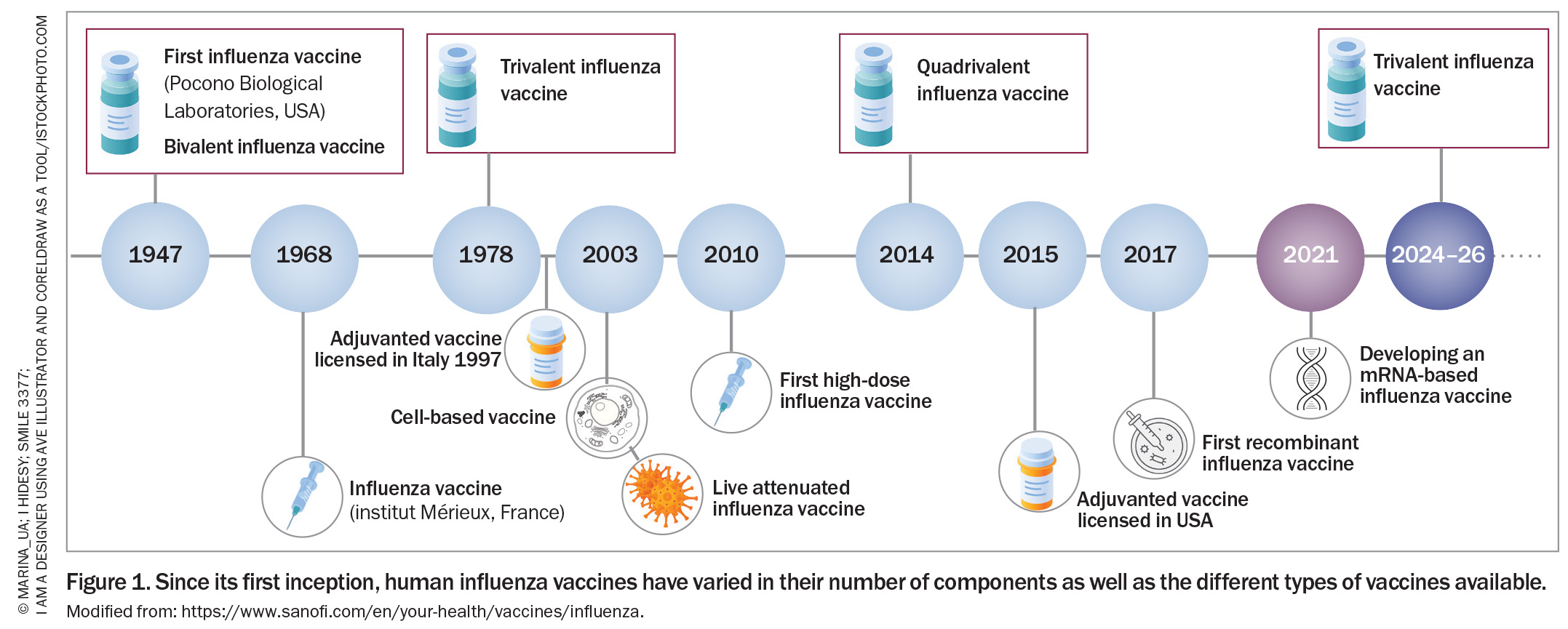
Overall, influenza vaccines have changed over time, with subtypes and lineages coming and going, and different viruses entering and leaving human circulation (Figure 1).
Who decides what goes into the influenza vaccines and how do they do it?
Since 1952, the WHO has played a central role in determining the composition of influenza vaccines. This function is carried out by the WHO under the auspices of the Global Influenza Surveillance and Response System, a large network of 165 National Influenza Centres spread across 138 countries.4 At the apex of this network are the WHO Collaborating Centres, including five that focus on human influenza, two that focus on zoonotic influenza and four Essential Regulatory Laboratories that supply reagents for standardising influenza vaccines. Experts from these centres, along with modelling groups, FAO-WOAH-OFFLU (a global network of expertise on animal influenza, co-ordinated by the Food and Agriculture Organization and the World Organisation for Animal Health), and other WHO representatives contribute to the decision-making process. Typically, about 40 to 60 participants attend each consultation meeting.
To better match influenza vaccines to the viruses that are in circulation, the WHO has held separate vaccine composition meetings (VCMs) for each hemisphere since 1999.5 These are held each year in late September for the Southern Hemisphere and late February for the Northern Hemisphere, allowing recommendations to reflect differing seasonal patterns, although some tropical regions, such as large parts of Brazil, do not neatly align with these distinctions.6 The WHO has compiled a table indicating which countries should ideally use Northern or Southern Hemisphere vaccine formulations based on local influenza seasonality.⁷
Following these recommendations, manufacturers produce and distribute vaccines for annual vaccination programs that begin from March onwards in the Southern Hemisphere and from August onwards in the Northern Hemisphere.
What happened at the latest Northern Hemisphere vaccine composition meeting?
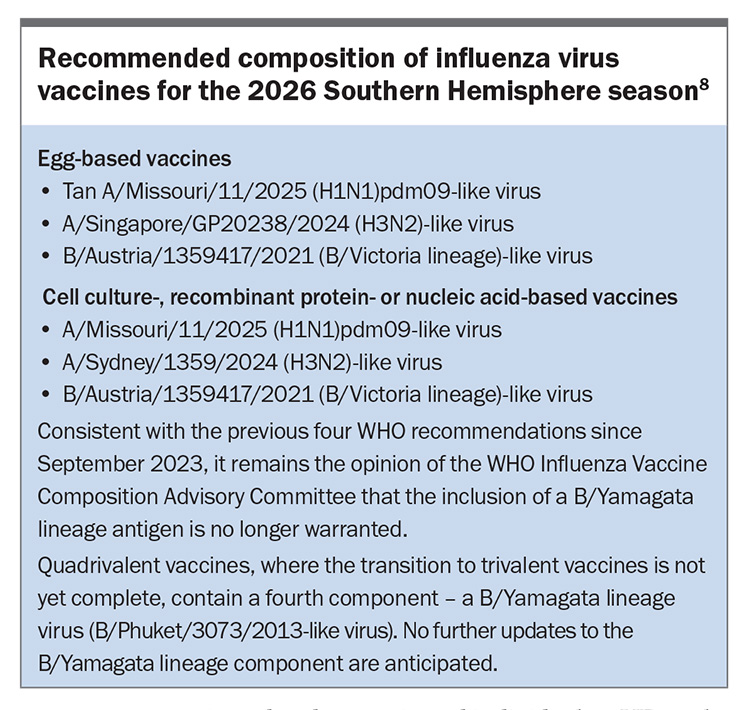
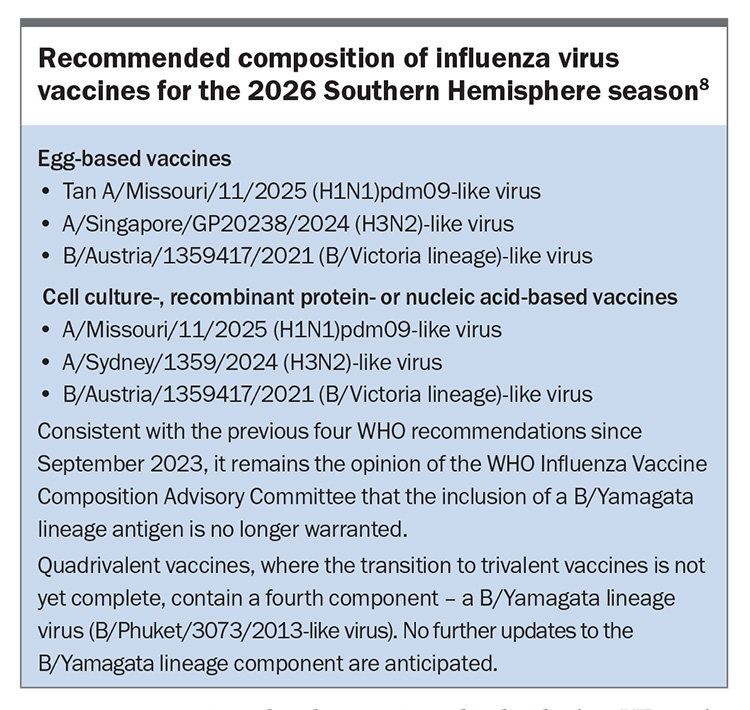
The most recent VCM for the Northern Hemisphere was held in Istanbul, Türkiye from 23–27 February 2026 to determine the vaccine for the 2026–27 influenza season. However, the more relevant meeting for Australia was the Southern Hemisphere VCM that was held in Sapporo, Japan, from 22–25 September 2025. This meeting determined the viruses to be included in the Southern Hemisphere 2026 influenza vaccine (Box),8 which was later ratified by the TGA’s Australian Influenza Vaccine Committee for use in Australia in 2026.9
At these meetings, the key questions are consistent, regardless of the hemisphere.
- Have the circulating influenza viruses (for A(H1N1)pdm09 or A(H3N2) or B viruses) changed significantly (globally, regionally or locally) compared with those identified at the previous VCM?
- Does the current vaccine show adequate protection against the currently circulating viruses and viruses predicted to widely circulate in the next nine to 12 months?
- Depending on the answers to the above questions and whether one, two or all three components require updating, are suitable candidate vaccine viruses available (i.e. those that provide adequate yield and closely match the newly selected prototype vaccine viruses) for production?
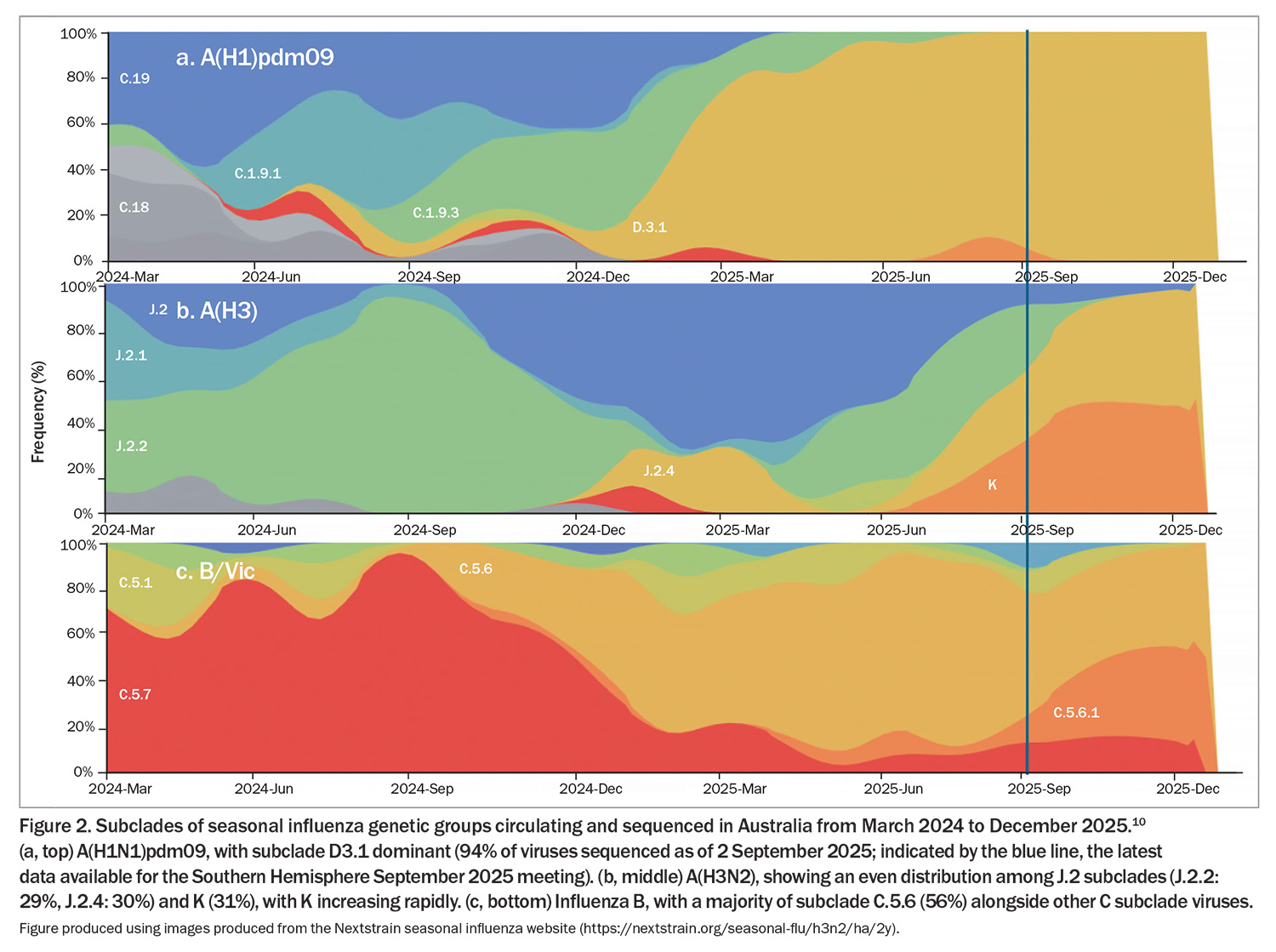
To address the first question for the 2026 Southern Hemisphere VCM, available data indicated that two of the three vaccine components needed updating: the A(H1N1)pdm09 and the A(H3N2). No change was required for the B/Vic component. Genetic subclade frequency plots, from February to September 2025, based on the haemagglutinin (HA) sequences showed dominance of the A(H1N1)pdm09 subclade (known as D.3.1) and the emergence of A(H3N2) subclade K (formerly called J.2.4.1).10 In contrast, B/Vic viruses showed relatively little change, with several subclades co-circulating. A similar situation was seen in Australia over this period (Figure 2).
The second question is addressed through both serological and clinical studies data. Sera from people of all ages (young children, adults and older people) who have been vaccinated with the current influenza vaccine are tested to determine whether serum antibodies can inhibit or neutralise the viruses circulating prior to the meeting and are likely to circulate in the future. If these antibodies are effective, particularly against new or emerging viruses, the need to update the vaccine is reduced. If they are not effective, and antibody inhibition levels are reduced by 50% or more, this indicates that the vaccine may need to be updated for that particular influenza type or subtype.
In addition to serological testing, the current vaccine is also assessed for its performance in preventing infection or hospitalisation over the current season. This is referred to as determining the vaccine effectiveness (VE) and can be estimated for the vaccines overall, as well as for each influenza type or subtype, or by age groups or by different vaccine types. The test-negative, case–control design is commonly used to estimate the VE, and, provided there are sufficient cases among vaccinated and unvaccinated individuals, a VE can be estimated against all circulating influenza viruses, specific types or subtypes of influenza, or even against influenza virus clades and subclades.11
These estimates are presented as point estimates with 95% confidence intervals (CIs). They may be less reliable if CIs are wide or cross zero. For example, the interim VE for the 2025 vaccine in Australia was 56% (95% CI, 40–68%) against presentation to a GP with influenza, and 49% (95% CI, 42–56%) against hospitalisation across all ages.12 The VE varies by age, influenza type or subtype, and even by subclade. A substantial reduction in VE in one or more age groups, or against specific influenza types or subtypes compared with previous seasons, may also prompt an update to that vaccine component.
Addressing the third question is also a critical element in the process of making influenza vaccines. It is necessary to have influenza viruses that are suitable for large-scale propagation in both egg- and cell-based production facilities. Recombinant protein-based vaccines and the emerging mRNA-based influenza vaccines (if they become available) are not subject to these same production issues.
All other vaccines require suitable viable influenza viruses to produce sufficient doses of inactivated or live attenuated influenza vaccines (LAIV), which together, currently account for over 95% of the global influenza vaccine market. Viruses suitable for production in egg- and cell-based systems are referred to as candidate vaccine viruses (CVVs). At the September 2025 VCM, a number of CVVs were available to support updating the A(H1N1)pdm09 component to an A/Missouri/ 11/2025-like virus. However, for the A(H3N2), no CVVs from the K subclade were available due to their late emergence, so viruses from preceding J.2.4 subclade were selected. These included A/Singapore/GP20238/2024-like viruses for egg-based production and A/Sydney/1359/2024-like viruses for cell-based, mRNA and recombinant protein-based systems (Box).
To produce the hundreds of millions of influenza vaccine doses each year, influenza type A viruses isolated from clinical samples are reassorted with high growth viruses, a process made possible by the segmented genome of influenza viruses and first developed by Ed Kilbourne in the 1960s.13,14 This is performed in specialist laboratories, typically by mixing the clinically obtained egg or cell virus isolate with a high-growth influenza virus (e.g. A/Puerto Rico/8/34), followed by selection using antisera and serial passaging. The resulting reassortant virus contains the HA and NA genes from the clinical strain and internal viral genes that support high-level replication in embryonated hen’s eggs or in a qualified cell line.
Alternatively, recombinant gene technologies can be used to generate vaccine viruses, although these approaches may classify the vaccine as a genetically modified organism in some countries (except in the USA, where genetically modified organism classifications do not apply). Regardless of the method used, generating reassortants typically takes three to four weeks and involves specialised expertise, which when added to the time to isolate a virus in qualified cells or embryonated eggs, means that it takes a total of five to seven weeks to produce each suitable CVV. Although egg-derived influenza B viruses have been reassorted to try and improve yield, this is less consistently required than for influenza A viruses, where egg reassortants are almost always used. These steps are not required for recombinant HA and mRNA vaccines, which rely only on sequence information, enabling faster production.
In addition to producing vaccine viruses, reagents are required to standardise vaccine potency. This involves generating large amounts of viral antigen and specific anti-HA antisera (typically derived from sheep) to measure HA content of vaccines. Standard trivalent vaccines contain at least 15 microg of HA per strain (total 45 microg), whereas high-dose vaccines contain at least 60 microg of HA per strain (total 180 microg). The trivalent recombinant HA vaccine contains 45 microg of HA per strain (total 135 microg), whereas the intranasal LAIV is measured by infectious units rather than HA content. These newer vaccines have been shown to be more effective in older people when adjuvanted or contain higher amounts of HA than standard-dose vaccines, whereas the LAIV has been shown to be the most effective in children. As a result, these vaccines have preferred recommendations for different products and age groups.16
In the event that a zoonotic virus emerges and either causes or threatens to cause a major epidemic or pandemic, the process for vaccine development is essentially the same as for seasonal influenza. This was demonstrated in 2009 when the A(H1N1)pdm09 pandemic strain emerged. Extraordinary meetings, akin to VCMs, were held shortly after the virus was identified in April 2009. CVVs and reagents were generated, and a monovalent vaccine was made available for vaccinations about six months later. The pandemic A(H1N1)pdm09 virus was then incorporated into the following seasonal influenza vaccine (the 2010 Southern Hemisphere vaccine), replacing the previous A(H1N1) component. If a similar situation occurred today, a comparable process would take place, likely including the emergency use of mRNA vaccines, given their shorter production timeline and demonstrated success against SARS-CoV-2. The ‘holy grail’ of a universal influenza vaccine, capable of protecting against all influenza A strains that might emerge from the animal world, remains some way off, despite more than 80 years of research and multiple different approaches.
Influenza vaccines for Australia in 2026
The types of influenza vaccines available in Australia in 2026 are the same as those in 2025, with one important exception: the introduction of the intranasal LAIV. This vaccine will be available in several states (New South Wales, Queensland, South Australia and Western Australia) through state-based immunisations programs free of charge. Other states and territories (Victoria, Tasmania, Northern Territory and Australian Capital Territory) will only have access to this vaccine through the private market for the registered age groups of 2- to 17-year-olds.15 Full Australian Technical Advisory Group on Immunisation guidance by age and vaccine brand for 2026 is available, along with a detailed statement on the administration of seasonal influenza vaccines in 2026.16 It is hoped that the introduction of the intranasal LAIV will help to increase the uptake of influenza vaccine in children, which has been low for many years. For example, in 2025, vaccine coverage in Australia was 25.7% for children aged 6 months to under 5 years and only 14.5% for those aged 5 to under 15 years.17 These figures have not changed or have declined across all age groups, as has been seen with many vaccines in the post-COVID-19 era.
It is important to remember that immunity levels to influenza wanes six to 12 months following infection or vaccination. Annual vaccination is therefore recommended, especially when one or more vaccine components are updated, as is the case for the 2026 Southern Hemisphere/Australian influenza vaccine, where two out of the three components have been updated.
Although many people involved in influenza surveillance, vaccine development and production strive to make influenza vaccines as effective and widely available as possible, vaccine hesitancy remains a significant ongoing challenge. Addressing these concerns is complex and will require multiple approaches over many years. Overcoming hesitancy will demand proactive and innovative efforts from all stakeholders.
Finally, how severe will the 2026 influenza season be in Australia? This is a difficult question to answer as influenza is unpredictable. Although the past three years have seen large seasons, with 2025 the largest on record based on laboratory-confirmed cases, this does not necessarily mean 2026 will be milder.18 Vaccination remains the most effective strategy to prevent or reduce the severity of infection, alongside the use of antiviral drugs such as oseltamivir or zanamivir for treatment and prophylaxis. RMT
COMPETING INTERESTS: Professor Barr holds shares in a vaccine production company.
References
1. Drake JW. Rates of spontaneous mutation among RNA viruses. Proc Natl Acad Sci U S A 1993; 90: 4171-4175.
2. Vijaykrishna D, Holmes EC, Joseph U, et al. The contrasting phylodynamics of human influenza B viruses. eLife 2015; 4: e05055.
3. Dhanasekaran V, Sullivan S, Edwards KM, et al. Human seasonal influenza under COVID-19 and the potential consequences of influenza lineage elimination. Nat Commun 2022 31; 13: 1721.
4. World Health Organization (WHO). Global Influenza Surveillance and Response System (GISRS). Geneva: WHO; 2026. Available online at: www.who.int/initiatives/global-influenza-surveillance-and-response-system (accessed April 2026).
5. World Health Organization (WHO), Global influenza program. Recommendations for influenza vaccine composition - archive 1998-2010. Geneva: WHO; 2009. Available online at: https://www.who.int/teams/global-influenza-programme/vaccines/who-recommendations/recommendations-for-influenza-vaccine-composition-archive (accessed April 2026).
6. de Mello WA, de Paiva TM, Ishida MA, et al. The dilemma of influenza vaccine recommendations when applied to the tropics: the Brazilian case examined under alternative scenarios. PLoS One 2009; 4(4): e5095.
7. World Health Organization (WHO). Which formulation? Geneva: WHO; 2016. Available online at: https://cdn.who.int/media/docs/default-source/emergency-preparedness/global-influenza-programme/recommendedvaccineformulationv2.pdf?sfvrsn=eaf3b86b_4 (accessed April 2026).
8. World Health Organization (WHO). Recommended composition of influenza virus vaccines for use in the 2026 southern hemisphere influenza season. Geneva; WHO; 2025. Available online at: https://www.who.int/publications/m/item/recommended-composition-of-influenza-virus-vaccines-for-use-in-the-2026-southern-hemisphere-influenza-season (Accessed March 2026).
9. Melbourne Vaccine Eduction Centre (MVEC). TGA: AIVC recommendations for the composition of influenza vaccines for Australia in 2026. Melbourne: MVEC; 2025. Available online at: https://mvec.mcri.edu.au/tga-aivc-recommendations-for-the-composition-of-influenza-vaccines-for-australia-in-2026/ (accessed April 2026).
10. Neher RA, Huddleston J, Bedford T, et al. Nomenclature for tracking of genetic variation of seasonal influenza viruses. Influenza Other Respir Viruses 2026; 20(2): e70230.
11. Sullivan SG, Feng S, Cowling BJ. Potential of the test-negative design for measuring influenza vaccine effectiveness: a systematic review. Expert Rev Vaccines 2014; 13: 1571-1591.
12. Australian Centre for Disease Control (CDC). Australian Respiratory Surveillance Report – 1 to 28 December 2025. Canberra: Australian CDC; 2026. Available online at: https://www.cdc.gov.au/resources/publications/australian-respiratory-surveillance-report-1-28-december-2025 (accessed April 2026).
13. Palache B, Fyyaz H, Thomson D, et al. The IFPMA IVS seasonal influenza vaccine dose distribution survey 2022-2023: evidence of the need for committed national investment in and uptake of seasonal influenza vaccination. Vaccine 2025; 64: 127747.
14. Kilbourne ED. Future influenza vaccines and the use of genetic recombinants. Bull World Health Organ 1969; 41: 643-645.
15. Medsinfo. FluMist influenza vaccine. Consumer Medicine Information (CMI) summary. Available online at: https://medsinfo.com.au/consumer-information/document/FluMist_CMI?drug_id=19493&documenttype=cmi (accessed April 2026).
16. Australian Government Department of Health, Disability and Ageing. Australian Technical Advisory Group on Immunisation Statement on the administration of seasonal influenza vaccines in 2026. Canberra: Australian Government; 2026. Available online at: https://www.health.gov.au/resources/publications/atagi-statement-on-the-administration-of-seasonal-influenza-vaccines-in-2026?language=en (accessed April 2026).
17. National Centre of Immunisation Research and Surveillance Australia. All persons: 2025 (YTD) influenza vaccination coverage by age group and state/territory. Canberra: NCIRS; 2025. Available online at: https://ncirs.org.au/influenza-vaccination-coverage-data/all-persons-2025-ytd-influenza-vaccination-coverage-age-group (accessed April 2026).
18. Australian Centre for Disease Control (CDC). National Notifiable Disease Surveillance System. Canberra: Australian CDC; 2026. Available online at: https://nindss.health.gov.au/pbi-dashboard/ (accessed April 2026).
Single article purchases are temporarily unavailable due to site maintenance.
If you would like to purchase an article during this time, please email us at [email protected] with the article details and we'll assist you directly. We'll also let you know when online purchasing is available again.
Thank you for your patience and understanding.